
What we know. Priego’s tourism service dates completion of the Baroque design to 1803. The title refers to the site’s long development, not continuous building work since the sixteenth century.
Listen first, then look
In Priego de Córdoba, water turns an urban space into a stage. Before searching for a particular sculpture, listen to the changing sound as you approach the basins. Then stand far enough back to follow their curves. The Fuente del Rey is more than a collection of isolated statues: flowing water connects its different parts.
The title needs a qualification. The site underwent changes from the sixteenth century onwards, but that does not mean a single project remained under construction for three hundred years. Priego’s tourism service dates completion of Remigio del Mármol’s Baroque design to 1803. The longer history belongs to successive ways of arranging the site and channelling its water.
Three basins, one composition
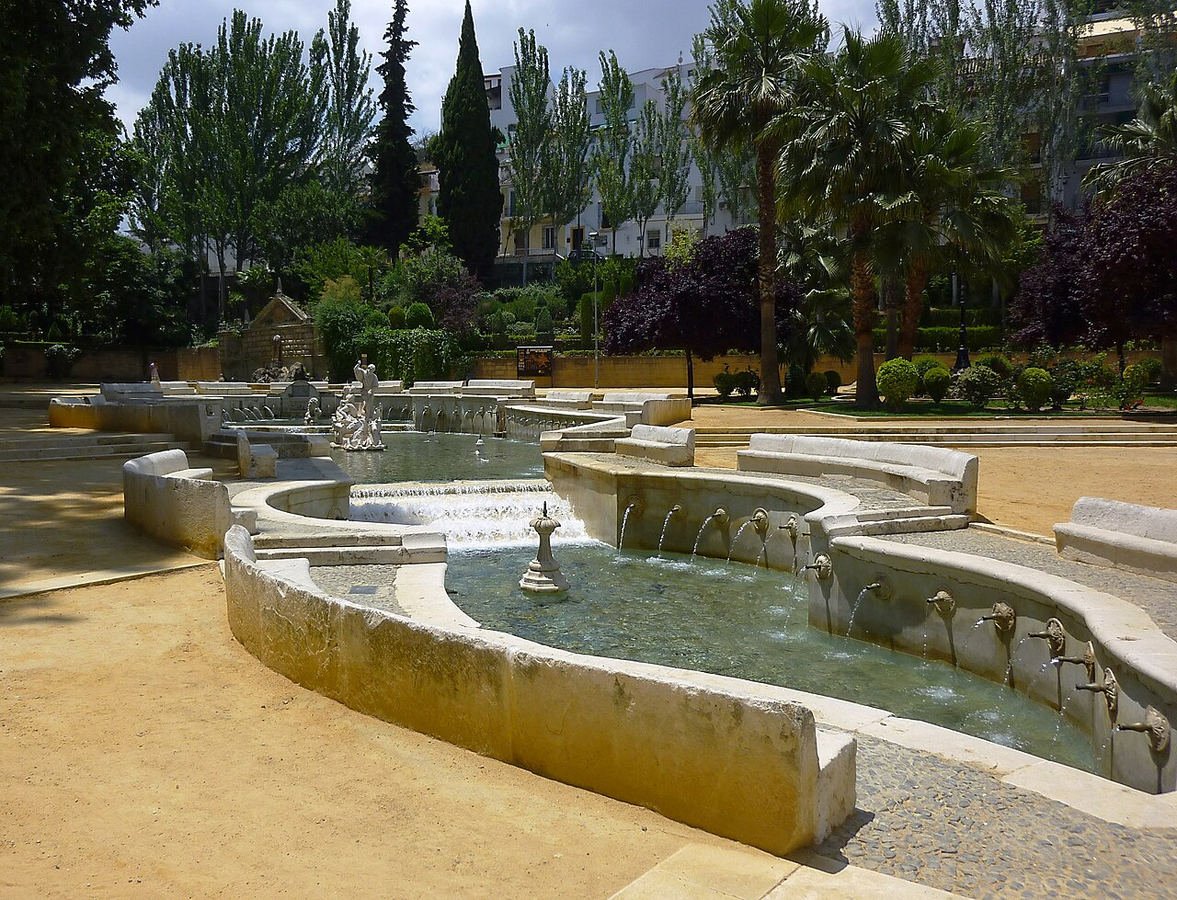
The fountain has three basins at different levels. Their curved outlines guide the eye, while water moves between them. Rather than relying on one frontal photograph, find two viewpoints along the public walk. A figure that seemed to dominate the whole may acquire a different relationship with the basins when seen from another position.
The first basin contains a lion fighting a snake. Municipal visitor information attributes this work to Álvarez Cubero. Keeping that qualification matters: an attribution should not become a stronger documentary certainty in the retelling. In the central group, Neptune and Amphitrite ride a chariot with horses emerging from the water. These are mythological figures within an artistic composition.
Details within the spectacle
Official sources record 139 spouts distributing water around the monument. Some have stone masks whose expressions reward a closer look. They need not be interpreted as apparitions or portraits of identified historical people. Observation can be imaginative without turning into a claim that the evidence does not support.
Mythology provides a language for representing mastery of water. The site also has a practical dimension: managing a spring and giving it a public presence. Monumental design does not erase that purpose. It turns it into an experience in which sound, stone and changes in level can be appreciated together.
Two fountains, different histories
The Fuente de la Salud stands in the same enclosure, but it is a separate sixteenth-century work. Its architectural façade contrasts with the Fuente del Rey’s sequence of basins. Comparing them reveals two ways of organising water and two stages in local history. The date 1803 should not be applied to everything within sight.
Finish by taking in the whole setting again. There is no need to imagine centuries of uninterrupted building. The more interesting story is a succession of choices that changed the town’s relationship with its spring. Continue into Priego, towards the Villa quarter and the Adarve viewpoint, to see how landscape shapes another experience of the town.
At your own pace
Audio guide
The fountain that took centuries to complete · 3:09 · English
Preparing player…
Read the full transcript
The fountain that took centuries to complete.
In Priego de Córdoba, water turns an urban space into a stage. Before searching for a particular sculpture, listen to the changing sound as you approach the basins. Then stand far enough back to follow their curves. The Fuente del Rey is more than a collection of isolated statues: flowing water connects its different parts.
The title needs a qualification. The site underwent changes from the sixteenth century onwards, but that does not mean a single project remained under construction for three hundred years. Priego’s tourism service dates completion of Remigio del Mármol’s Baroque design to eighteen oh-three. The longer history belongs to successive ways of arranging the site and channelling its water.
The fountain has three basins at different levels. Their curved outlines guide the eye, while water moves between them. Rather than relying on one frontal photograph, find two viewpoints along the public walk. A figure that seemed to dominate the whole may acquire a different relationship with the basins when seen from another position.
The first basin contains a lion fighting a snake. Municipal visitor information attributes this work to Álvarez Cubero. Keeping that qualification matters: an attribution should not become a stronger documentary certainty in the retelling. In the central group, Neptune and Amphitrite ride a chariot with horses emerging from the water. These are mythological figures within an artistic composition.
Official sources record one hundred and thirty-nine spouts distributing water around the monument. Some have stone masks whose expressions reward a closer look. They need not be interpreted as apparitions or portraits of identified historical people. Observation can be imaginative without turning into a claim that the evidence does not support.
Mythology provides a language for representing mastery of water. The site also has a practical dimension: managing a spring and giving it a public presence. Monumental design does not erase that purpose. It turns it into an experience in which sound, stone and changes in level can be appreciated together.
The Fuente de la Salud stands in the same enclosure, but it is a separate sixteenth-century work. Its architectural façade contrasts with the Fuente del Rey’s sequence of basins. Comparing them reveals two ways of organising water and two stages in local history. The date eighteen oh-three should not be applied to everything within sight.
Finish by taking in the whole setting again. There is no need to imagine centuries of uninterrupted building. The more interesting story is a succession of choices that changed the town’s relationship with its spring. Continue into Priego, towards the Villa quarter and the Adarve viewpoint, to see how landscape shapes another experience of the town.
The Fuente del Rey is in Priego de Córdoba, a separate town from Córdoba city. Listen from pedestrian areas and respect closures or conservation work. Check local visitor information before travelling. Stay off the basin edges and do not assume the fountain water is drinking water.
Download for offline listening
Save this story before you leave. Its recording and page will be available in this browser. Maps, bookings and external links require a connection.
Locally generated neural narration · Emma · This story’s full script. Audio credits
What to notice and how to plan your visit
The Fuente del Rey is in Priego de Córdoba, a separate town from Córdoba city. Listen from pedestrian areas and respect closures or conservation work. Check local visitor information before travelling. Stay off the basin edges and do not assume the fountain water is drinking water.
Sources and a critical reading
Documented evidence is distinguished from tradition and interpretation. Check current visitor arrangements. References are in Spanish unless marked English.