
What we know. Literary legend. Association with a particular house or set of arches does not prove that the episode happened there.
A father faced with an unbearable loss
Recognition gives this tale its force. In the traditional account, Gonzalo Gustioz does not receive distant news: his sons’ heads are brought before him. The scene slows the story down and turns a military defeat into a father’s grief. Its emotional power helps explain why people continued to tell it; that power is not evidence that every detail took place.
Why there is no single definitive version
Here, infantes means young noblemen, not necessarily royal princes. Their story belongs to Castilian epic tradition and survives in different literary accounts. The scholar Alan Deyermond examined how the chronicles vary: the revenge story and the roles of Mudarra and the women develop differently. Combining every memorable detail into one supposedly factual narrative would conceal those differences.
What the street can tell us
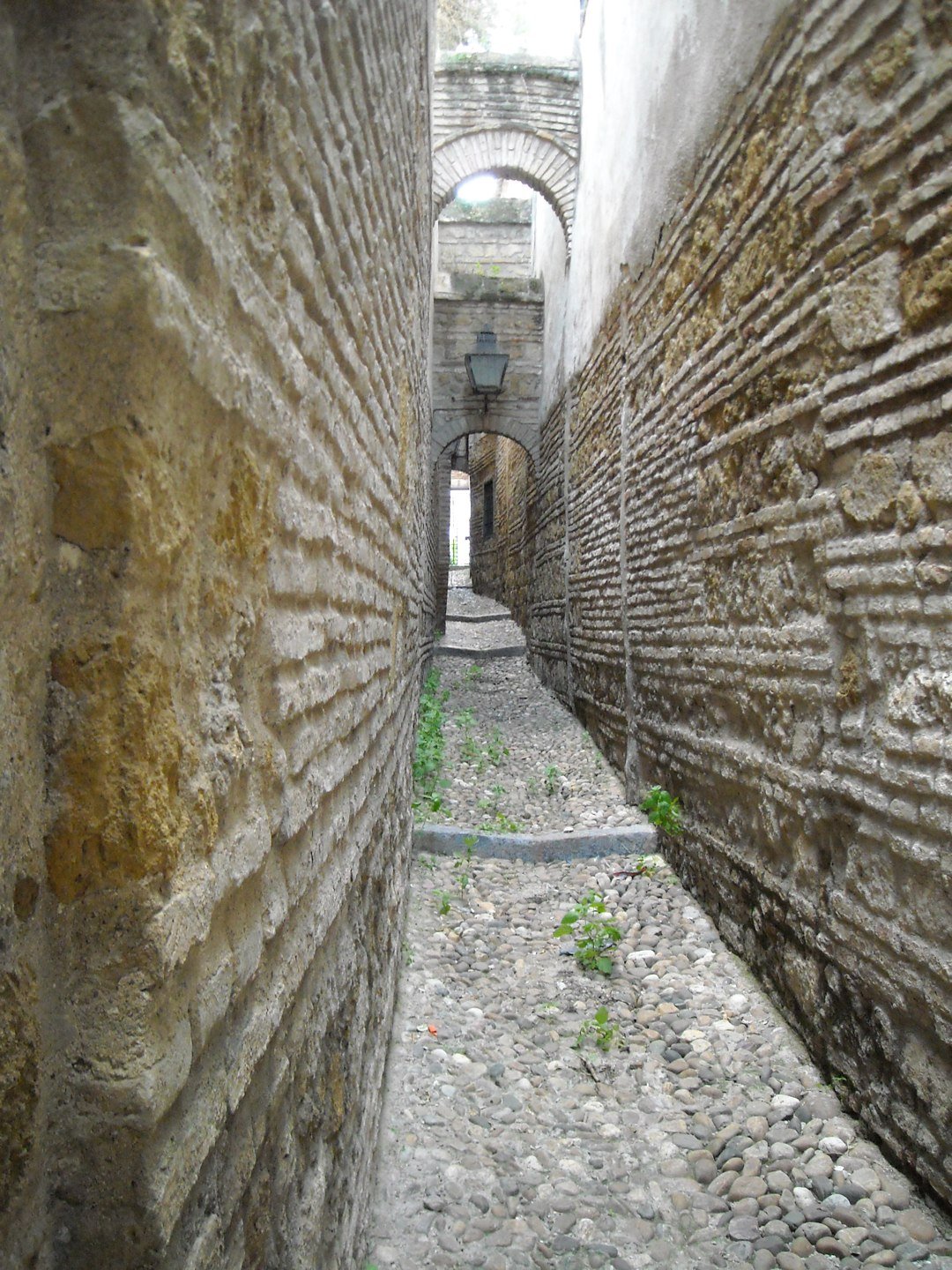
Córdoba’s municipal tourist information associates this street with the seven brothers’ legend and notes the nearby tower of the palace of the Marquises of El Carpio. That helps locate the story; it does not date surviving arches through the legend or establish that a present-day house was Almanzor’s prison. The photograph shows the Callejón de los Arquillos associated with the tale, rather than a historical reconstruction.
A different question to take on your walk
Notice how the street name, narrow passages and narrative work together. Instead of asking whether the scene happened beneath one particular arch, ask why this corner came to be remembered through an epic tale. You can enjoy that connection without treating the surviving buildings as proof of the story.
Listen at your own pace
Uses your device’s English voice, not a new recording. Offline availability depends on installed voices.
Read the narration script
In a narrow street near the riverside, the name Cabezas invites you to look up. Local tradition placed here the ending of a tale carried for centuries in Spanish ballads: the Seven Infantes of Lara. A house name preserves the story; it does not prove that the events happened within these walls.
According to the legend, the seven brothers are caught in an ambush. Their heads are brought to Córdoba and shown to their father, Gonzalo Gustioz, a prisoner of Almanzor. He recognises his sons and mourns them one by one. A distant defeat becomes an intensely personal loss.
The cycle continues with Mudarra, the brothers’ half-brother, who is called to avenge them. Accounts vary, as often happens with transmitted stories: betrayal, grief and retribution matter more than a precise description of the city.
Look at the scale of the street. Its narrowness helps you understand how a legend can become attached to a place. Enjoy the connection between stone and memory without asking every arch to serve as archaeological proof.
Where to stop and what to notice
Start in Calle Cabezas, near the Portillo. Observe from spaces open to pedestrians: a street, a passage and a ticketed interior are different things. If a gate is closed or access has conditions, ask the operator. This guide does not guarantee entry to the Casa de las Cabezas or the alley. Continue towards Plaza del Potro and the riverside if you want a longer walk.
Sources and a critical reading
Sources establish the building, the discovery or the transmission of a tale. Recording a legend does not establish that its events took place.