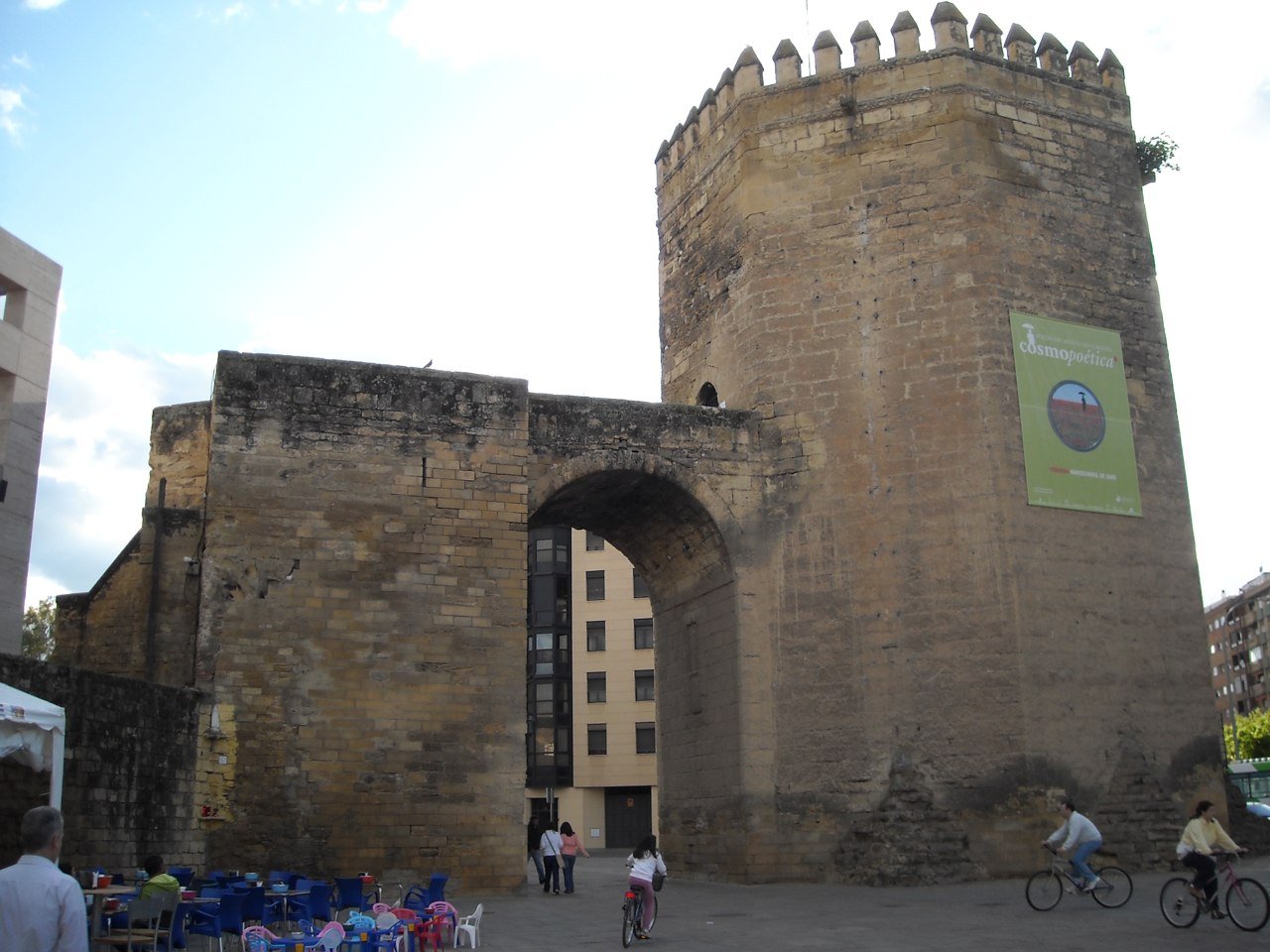

What we know. The medieval building is documented. Its supposed construction by a jealous husband as penance belongs to legend, rather than a demonstrated account of its origin.
Begin with the shape, rather than the name
The octagonal outline and connecting arch offer a useful starting point. This is an albarrana tower: a detached tower linked to the main defensive system. Its position had a military purpose. The name may suggest a private tragedy, but the building’s form first tells the story of a fortification.
What the dates actually refer to
The municipal protected-buildings catalogue, entry MA-17, dates the tower to 1406–1408. A Córdoba tourist-office guide gives 1404–1408, including the earlier order for the work. The inscription transcribed in the sources records a start in 1406 and completion in 1408. Keeping that construction process separate from a legendary chronology makes the monument easier to understand.
A tale that explains a troubling name
The best-known version tells of a woman unjustly killed by her jealous husband, with the tower built as his penance. It offers a narrative explanation for the name. A source recording the tale establishes that it was told; it does not establish that this husband financed or built the tower. No crime is attributed here to an identifiable person without supporting records.
Reading a nineteenth-century guide critically
In Paseos por Córdoba , preserved by the municipal library, Ramírez de Arellano records local traditions and contrasts them with information about construction. His writing helps us understand how nineteenth-century Córdoba told its own stories. A belief does not become a proven medieval event simply because it appears in an old book.
A story of injustice, not a named accusation
The legend is often told as a husband’s violent response to jealousy, followed by a demand for reparation. It is important not to turn that narrative into an accusation against an identified historical person without evidence. The woman’s wrongful death gives the tale its moral force. It does not supply a documented building contract or a reliable account of the tower’s origin.
There are two different ways to look at the site. Architecture asks how a detached defensive tower worked with the city wall. The legend asks how a disturbing name became memorable. One need not erase the other. Keeping the questions separate allows the dramatic story to be heard without allowing it to replace the surviving evidence.
Look beyond the name
From a safe pavement, compare the tower’s mass with the arch connecting it to the defensive line. A photograph may make them seem like an isolated landmark, while a walk encourages you to imagine a larger urban boundary. You do not need access to the interior to ask how the building relates to its surroundings.
The story can continue towards Santa Marina or the eastern city’s walls. The Axerquía account explores another stretch of Córdoba’s defences, where archaeological evidence also complicates a simple date. Leave the Malmuerta with both readings intact: a real fortification with a history to investigate, and a legend whose power comes from how it has been told.
At your own pace
Audio guide
Malmuerta Tower: the legend and the surviving stone · 3:14 · English
Preparing player…
Read the full transcript
Malmuerta Tower: the legend and the surviving stone.
The octagonal outline and connecting arch offer a useful starting point. This is an albarrana tower: a detached tower linked to the main defensive system. Its position had a military purpose. The name may suggest a private tragedy, but the building’s form first tells the story of a fortification.
The municipal protected-buildings catalogue, entry MA-17, dates the tower to fourteen oh-six to fourteen oh-eight. A Córdoba tourist-office guide gives fourteen oh-four to fourteen oh-eight, including the earlier order for the work. The inscription transcribed in the sources records a start in fourteen oh-six and completion in fourteen oh-eight. Keeping that construction process separate from a legendary chronology makes the monument easier to understand.
The best-known version tells of a woman unjustly killed by her jealous husband, with the tower built as his penance. It offers a narrative explanation for the name. A source recording the tale establishes that it was told; it does not establish that this husband financed or built the tower. No crime is attributed here to an identifiable person without supporting records.
In Paseos por Córdoba , preserved by the municipal library, Ramírez de Arellano records local traditions and contrasts them with information about construction. His writing helps us understand how nineteenth-century Córdoba told its own stories. A belief does not become a proven medieval event simply because it appears in an old book.
The legend is often told as a husband’s violent response to jealousy, followed by a demand for reparation. It is important not to turn that narrative into an accusation against an identified historical person without evidence. The woman’s wrongful death gives the tale its moral force. It does not supply a documented building contract or a reliable account of the tower’s origin.
There are two different ways to look at the site. Architecture asks how a detached defensive tower worked with the city wall. The legend asks how a disturbing name became memorable. One need not erase the other. Keeping the questions separate allows the dramatic story to be heard without allowing it to replace the surviving evidence.
From a safe pavement, compare the tower’s mass with the arch connecting it to the defensive line. A photograph may make them seem like an isolated landmark, while a walk encourages you to imagine a larger urban boundary. You do not need access to the interior to ask how the building relates to its surroundings.
The story can continue towards Santa Marina or the eastern city’s walls. The Axerquía account explores another stretch of Córdoba’s defences, where archaeological evidence also complicates a simple date. Leave the Malmuerta with both readings intact: a real fortification with a history to investigate, and a legend whose power comes from how it has been told.
The tower stands near Plaza de Colón and Avenida de las Ollerías. View its outline and arch from safe public pavements. The inscription can be hard to read; do not step into traffic for a closer look. Interior access must be checked independently and is not guaranteed here.
Download for offline listening
Save this story before you leave. Its recording and page will be available in this browser. Maps, bookings and external links require a connection.
Locally generated neural narration · Emma · This story’s full script. Audio credits
What to notice and how to plan your visit
The tower stands near Plaza de Colón and Avenida de las Ollerías. View its outline and arch from safe public pavements. The inscription can be hard to read; do not step into traffic for a closer look. Interior access must be checked independently and is not guaranteed here.
Sources and a critical reading
Documented evidence is distinguished from tradition and interpretation. Check current visitor arrangements. References are in Spanish unless marked English.