
What we know. Continuity of place does not make every part of a building the same age. Its successive uses are documented; assigning an old function to a specific room requires particular evidence.
A site is not the same as a building
An easy way to misread the Alcázar is to imagine all its periods surviving, complete and neatly layered, behind every doorway. The site has a long history, but today’s complex is not an untouched Umayyad palace. The city dates Alfonso XI’s building campaign to 1328, within an area associated with the earlier palatial enclosure.
Separating the site from its buildings makes the story more interesting. New authorities could inherit a strategic position and an established association with power while changing the spaces themselves. Rather than collecting royal names as though they occupied an unchanging stage, ask what each institution required and what it might have altered.
When a residence becomes a tribunal
Royal occupation was one chapter, not the last. During the early modern period the Alcázar housed the Inquisition. This was more than a change of occupants: spaces expressing residential authority served a judicial and religious institution. That role deserves documentary explanation, without turning every corridor into an imagined torture chamber.
A specific clue survives in today’s Hall of Mosaics. The municipal virtual tour identifies the room as a former Inquisition chapel, remodelled in the eighteenth century. A space now approached as an art display once had a different use and meaning. Architecture helps frame that transformation, but cannot justify inventing what happened to a particular person in an unidentified corner.
Prison and military occupation
The city’s account places its use as a prison between 1822 and 1931. Military facilities followed, before transfer to the municipality in 1955. Those stages can be easy to miss when a visit centres on pools and gardens, yet they reveal a monument that continued to participate in modern urban life.
Reusing a building changes movement, practical requirements and forms of control. A doorway might organise court ceremony in one period and regulate confinement in another. That does not mean we can assign either role to the particular doorway in front of us. Keeping the complex’s documented history separate from interpretation of individual features avoids a misleading impression of precision.
A museum changes meaning too
Municipal recovery opened a further chapter: preservation and display. The Roman mosaics from the Corredera displayed here were discovered during separate works in 1958 and 1959, then presented on the walls of a room of much later origin. They were not found as floors in Alfonso XI’s palace, nor prove that the medieval Alcázar had this decoration.
That meeting of objects and building asks us to look in two directions. A mosaic leads back to a Roman home elsewhere in Córdoba; its display room recalls the Alcázar’s later uses. The discoveries have their own companion story. Here the focus is how a long-used complex became a place from which to interpret the city.
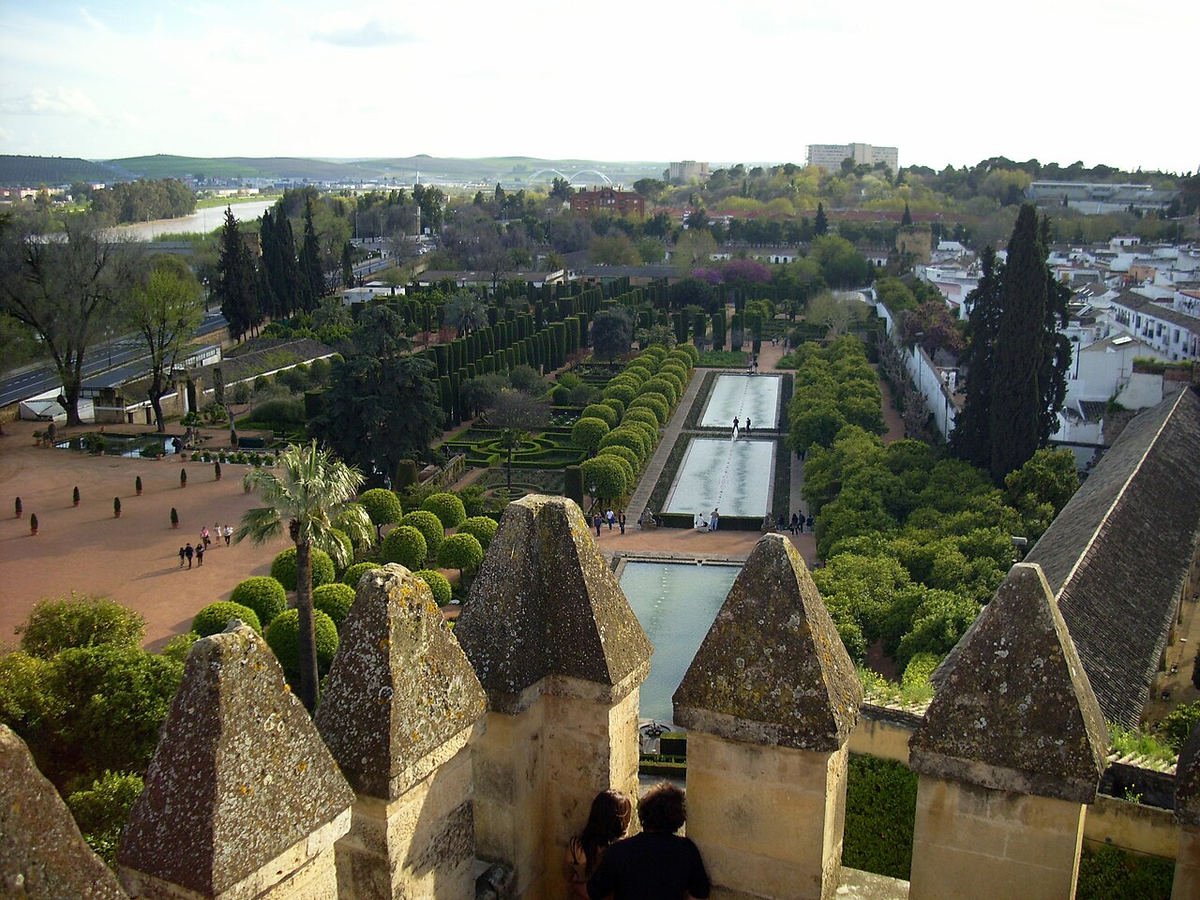
Before leaving, choose one view of the walls and one permitted interior. Do not expect either to show a Córdoba frozen in time. Ask what was retained, what was adapted and what today’s presentation allows us to understand. That changing biography is one of the monument’s greatest qualities.
At your own pace
Audio guide
The many lives of Córdoba’s Alcázar · 3:34 · English
Preparing player…
Read the full transcript
The many lives of Córdoba’s Alcázar.
An easy way to misread the Alcázar is to imagine all its periods surviving, complete and neatly layered, behind every doorway. The site has a long history, but today’s complex is not an untouched Umayyad palace. The city dates Alfonso the Eleventh’s building campaign to thirteen twenty-eight, within an area associated with the earlier palatial enclosure.
Separating the site from its buildings makes the story more interesting. New authorities could inherit a strategic position and an established association with power while changing the spaces themselves. Rather than collecting royal names as though they occupied an unchanging stage, ask what each institution required and what it might have altered.
Royal occupation was one chapter, not the last. During the early modern period the Alcázar housed the Inquisition. This was more than a change of occupants: spaces expressing residential authority served a judicial and religious institution. That role deserves documentary explanation, without turning every corridor into an imagined torture chamber.
A specific clue survives in today’s Hall of Mosaics. The municipal virtual tour identifies the room as a former Inquisition chapel, remodelled in the eighteenth century. A space now approached as an art display once had a different use and meaning. Architecture helps frame that transformation, but cannot justify inventing what happened to a particular person in an unidentified corner.
The city’s account places its use as a prison between eighteen twenty-two and nineteen thirty-one. Military facilities followed, before transfer to the municipality in nineteen fifty-five. Those stages can be easy to miss when a visit centres on pools and gardens, yet they reveal a monument that continued to participate in modern urban life.
Reusing a building changes movement, practical requirements and forms of control. A doorway might organise court ceremony in one period and regulate confinement in another. That does not mean we can assign either role to the particular doorway in front of us. Keeping the complex’s documented history separate from interpretation of individual features avoids a misleading impression of precision.
Municipal recovery opened a further chapter: preservation and display. The Roman mosaics from the Corredera displayed here were discovered during separate works in nineteen fifty-eight and nineteen fifty-nine, then presented on the walls of a room of much later origin. They were not found as floors in Alfonso the Eleventh’s palace, nor prove that the medieval Alcázar had this decoration.
That meeting of objects and building asks us to look in two directions. A mosaic leads back to a Roman home elsewhere in Córdoba; its display room recalls the Alcázar’s later uses. The discoveries have their own companion story. Here the focus is how a long-used complex became a place from which to interpret the city.
Before leaving, choose one view of the walls and one permitted interior. Do not expect either to show a Córdoba frozen in time. Ask what was retained, what was adapted and what today’s presentation allows us to understand. That changing biography is one of the monument’s greatest qualities.
Check the Alcázar’s official website for admission, itineraries and available areas. This story complements the main visitor guide; it does not guarantee entry to a particular room or tower. The nearby Caliphal Baths are a separate site and should not be confused with the bathing rooms within the Christian Alcázar.
Download for offline listening
Save this story before you leave. Its recording and page will be available in this browser. Maps, bookings and external links require a connection.
Locally generated neural narration · Emma · This story’s full script. Audio credits
Where to stop and what to notice
Check the Alcázar’s official website for admission, itineraries and available areas. This story complements the main visitor guide; it does not guarantee entry to a particular room or tower. The nearby Caliphal Baths are a separate site and should not be confused with the bathing rooms within the Christian Alcázar.
Sources and a critical reading
Sources distinguish documented history, transmitted tradition and interpretation. References are in Spanish unless marked English.