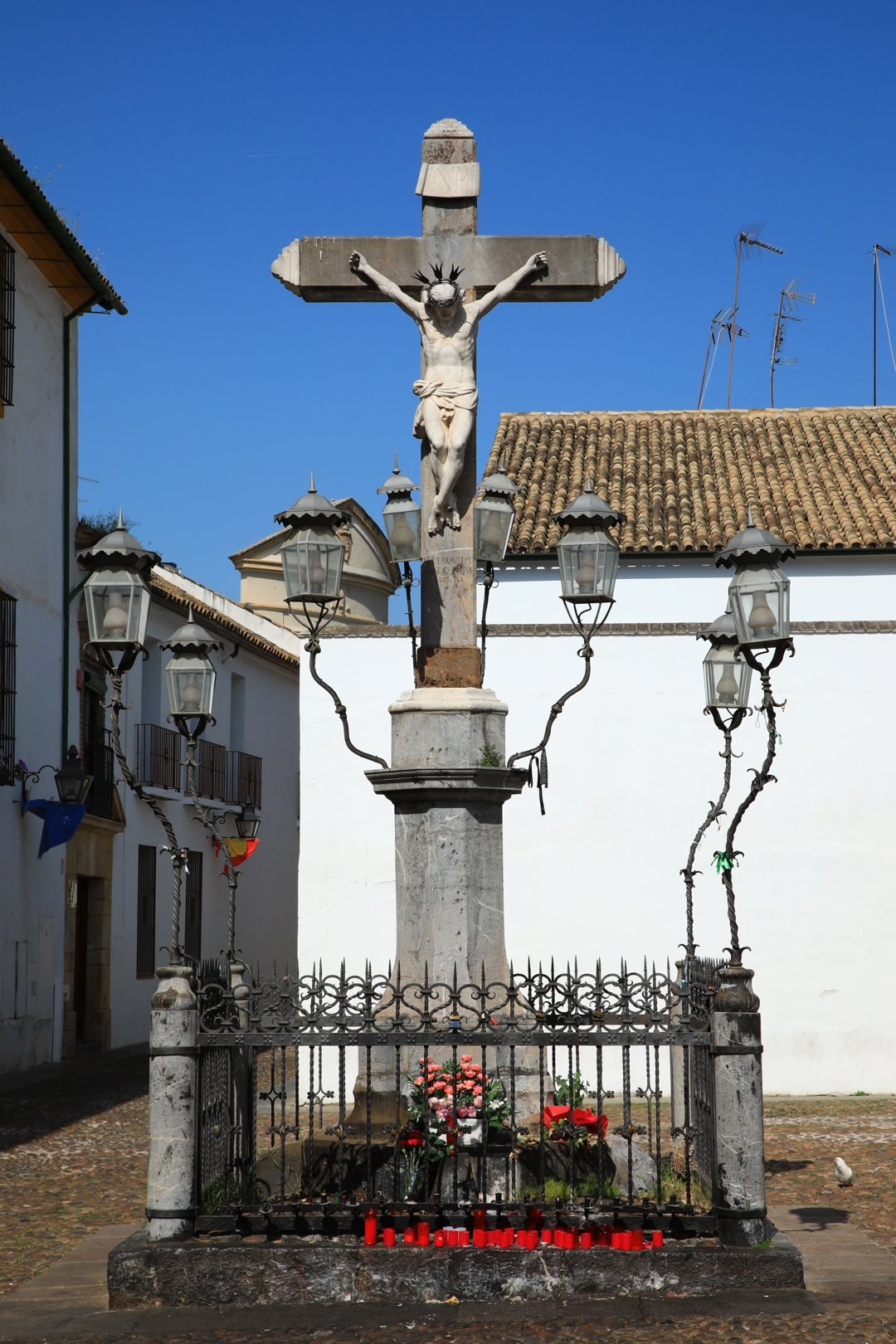

What we know. The monument is historical. The hooded visitor and his rescue belong to a recorded legend, with insufficient evidence to establish the episode.
Before the mystery, a moment to look
In Capuchinos, begin by pausing before you raise your camera. The cross, lanterns and enclosing walls create a scene worth studying slowly. Nothing extraordinary needs to happen for this place to be interesting. Part of its character lies in the relationship between a shared square and an image before which people still stop to pray.
The institutional guide Christian Córdoba dates the monument to 1794 and records its devotional name, Cristo de los Desagravios y Misericordias, invoking reparation and mercy. It also connects the name Capuchinos with the seventeenth-century Santo Ángel convent. These details place the setting within a religious history that predates the fame of its night-time tales.
The hooded visitor
In the version published by Ateneo Histórico Cultural, a hooded man approaches the Christ each night. His concealed identity invites speculation until he is said to explain that he is a soldier who survived a robbery. He returns out of gratitude for his rescue.
The heart of this tale is an obligation to give thanks, rather than a ghostly appearance. The account supplies no documentary evidence identifying the soldier or dating the attack. We therefore treat it as legend. A cultural organisation recording a story helps us understand its transmission; it does not establish that the events occurred.
Two names, two ways of remembering
Faroles means lanterns: the familiar name points to the eight lights around the cross. The devotional name expresses a different understanding of the image. Holding both in mind prevents the square from becoming merely a mysterious backdrop. Some visitors come for cultural interest; others come to pray.
Look from the edge of the square, leaving room for people to pass and space for anyone praying. Notice how the cross occupies the surrounding openness. For a different kind of memory, continue to the companion story about old postcards: there the clues lie in photographs, rather than a hooded visitor.
Listen at your own pace
Uses your device’s English voice, not a new recording. Offline availability depends on installed voices.
Read the narration script
Two kinds of memory meet in Capuchinos. One has a date: the Cristo de los Faroles monument is dated to 1794. The other takes the shape of a legend: a hooded soldier is said to return each night to give thanks for surviving a robbery. There is insufficient evidence to treat his rescue as documented history. Look at the eight lanterns and remember that the image also has a devotional name invoking reparation and mercy. The story speaks of gratitude; the square remains a place of reflection. Enjoy its atmosphere while respecting people praying or living nearby.
Where to stop and what to notice
Find the monument in Plaza de Capuchinos. You can connect it with the nearby Cuesta del Bailío steps, checking your route before setting off. This is an exterior viewing suggestion, not a promise of convent access or an accessibility assessment. Keep night-time visits quiet.
Sources and a critical reading
The linked records distinguish documented changes from interpretation. Sources are in Spanish unless marked otherwise.