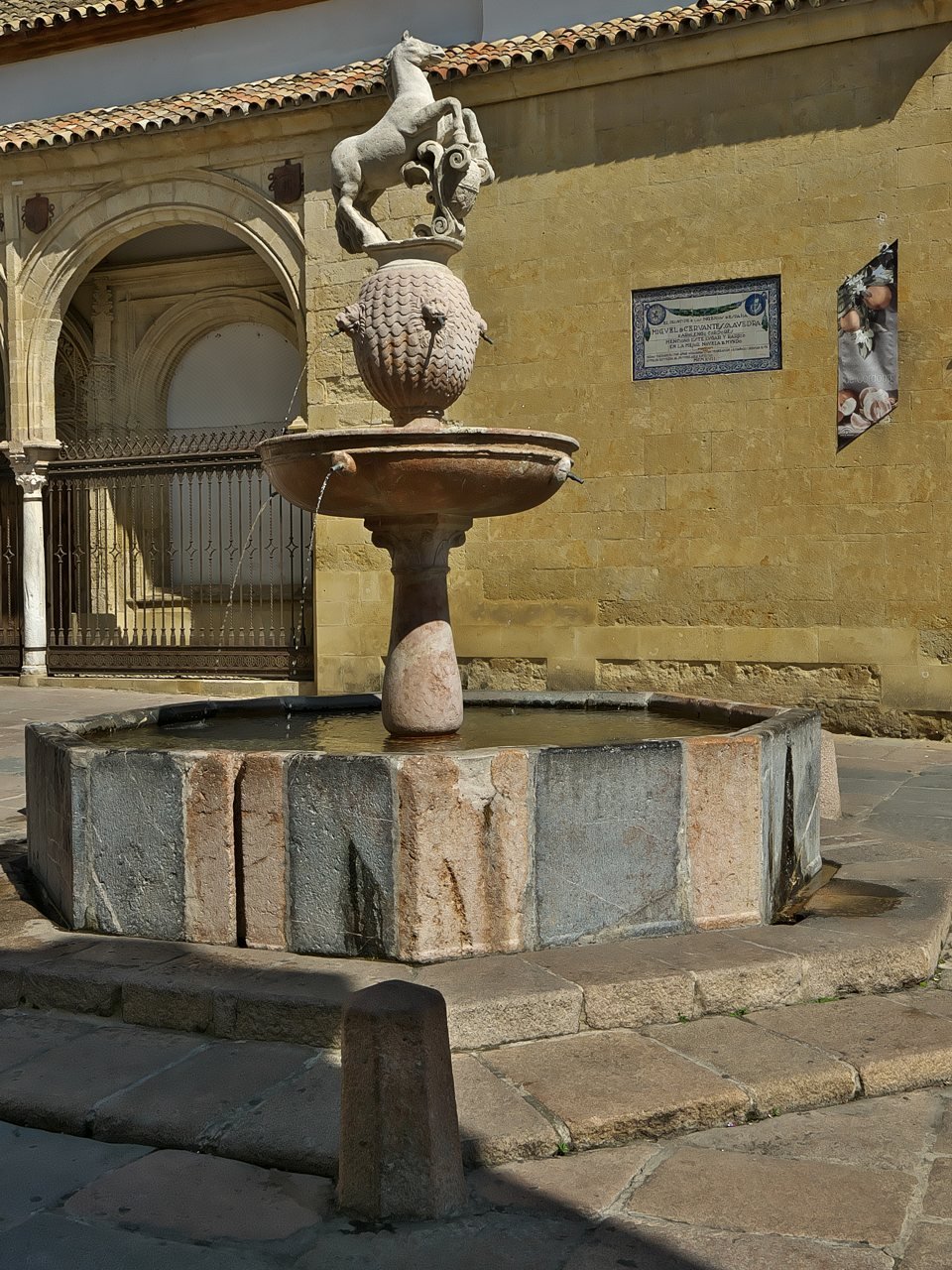

What we know. The fountain, its horse figure and its relocation belong to different stages. The official tourism sources consulted do not settle the precise origin of the name.
A small horse, a larger question
Look up at the figure crowning the fountain, then read the square’s name again. Potro means a young horse, or colt. The connection seems immediate, but recognising the figure does not establish which place received the name first or how the name passed between them.
IMTUR records the explanation associated with the little horse, while also treating a connection with the inn of the same name as plausible. Presenting both proposals is more accurate than turning one into certainty. This account identifies no real horse that founded the square, nor a single proven episode behind its name.
The fountain arrived in stages
The official account dates the fountain to 1577, during Philip II’s reign, and explains its purpose as a neighbourhood water supply. The horse was added roughly a century later. Separating these stages prevents us from imagining the whole composition completed at once or assigning the same age to every element.
Its position changed too. IMTUR records a move in 1847 from the spot now occupied by the triumphal monument to Saint Raphael to its present location. Looking between the two landmarks reveals another way to read the square: familiar objects have not necessarily always stood where we see them today.
Read the square without filling every gap
Locate the fountain and Saint Raphael’s monument, then look at the buildings framing the square. This connects historical information to a real place; it cannot reconstruct every market stall or animal that once passed through it.
Nearby lodging and commercial activity help explain the setting’s connection with travellers. That story belongs to the companion page about Posada del Potro. Here the subject is different: how a figure, a name and an everyday water supply became part of Córdoba’s recognisable image.
If you are visiting with children, start by finding the little horse, then ask what other evidence would help explain an old place name. You do not need to promise a final answer. Looking closely can also mean understanding what is known and what remains uncertain.
The water supply behind the emblem
A public fountain met a practical need in the neighbourhood. Thinking about water as a service helps explain why such structures mattered to everyday urban life. Utility and decoration could coexist, even when the feature most readily remembered today is the small animal above the basin.
The square’s interest lies in these accumulated changes: a daily need, a figure added later and a relocation that altered the arrangement of the space. Separate processes eventually produced a familiar symbol. Looking at them individually makes the fountain’s history clearer, without expecting the little horse to provide a final explanation of the square’s entire past.
At your own pace
Audio guide
The little horse behind Plaza del Potro · 3:05 · English
Preparing player…
Read the full transcript
The little horse behind Plaza del Potro.
Look up at the figure crowning the fountain, then read the square’s name again. Potro means a young horse, or colt. The connection seems immediate, but recognising the figure does not establish which place received the name first or how the name passed between them.
IMTUR records the explanation associated with the little horse, while also treating a connection with the inn of the same name as plausible. Presenting both proposals is more accurate than turning one into certainty. This account identifies no real horse that founded the square, nor a single proven episode behind its name.
The official account dates the fountain to fifteen seventy-seven, during Philip the Second’s reign, and explains its purpose as a neighbourhood water supply. The horse was added roughly a century later. Separating these stages prevents us from imagining the whole composition completed at once or assigning the same age to every element.
Its position changed too. IMTUR records a move in eighteen forty-seven from the spot now occupied by the triumphal monument to Saint Raphael to its present location. Looking between the two landmarks reveals another way to read the square: familiar objects have not necessarily always stood where we see them today.
Locate the fountain and Saint Raphael’s monument, then look at the buildings framing the square. This connects historical information to a real place; it cannot reconstruct every market stall or animal that once passed through it.
Nearby lodging and commercial activity help explain the setting’s connection with travellers. That story belongs to the companion page about Posada del Potro. Here the subject is different: how a figure, a name and an everyday water supply became part of Córdoba’s recognisable image.
If you are visiting with children, start by finding the little horse, then ask what other evidence would help explain an old place name. You do not need to promise a final answer. Looking closely can also mean understanding what is known and what remains uncertain.
A public fountain met a practical need in the neighbourhood. Thinking about water as a service helps explain why such structures mattered to everyday urban life. Utility and decoration could coexist, even when the feature most readily remembered today is the small animal above the basin.
The square’s interest lies in these accumulated changes: a daily need, a figure added later and a relocation that altered the arrangement of the space. Separate processes eventually produced a familiar symbol. Looking at them individually makes the fountain’s history clearer, without expecting the little horse to provide a final explanation of the square’s entire past.
Find the fountain in Plaza del Potro, then continue to the inn or explore the nearby museums. View the horse from public areas without climbing onto the monument. This suggestion makes no claim that the water is drinkable and does not establish access hours for surrounding buildings.
Download for offline listening
Save this story before you leave. Its recording and page will be available in this browser. Maps, bookings and external links require a connection.
Locally generated neural narration · Emma · This story’s full script. Audio credits
What to notice and how to plan your visit
Find the fountain in Plaza del Potro, then continue to the inn or explore the nearby museums. View the horse from public areas without climbing onto the monument. This suggestion makes no claim that the water is drinkable and does not establish access hours for surrounding buildings.
Sources and a critical reading
Documented evidence, popular comparisons and interpretations are distinguished. Check current access arrangements before visiting. References are in Spanish unless marked English.