
What we know. The building’s history and uses follow documentation published by the Fosforito Flamenco Centre. A literary connection with Cervantes does not itself prove that he stayed here.
A building designed to receive people
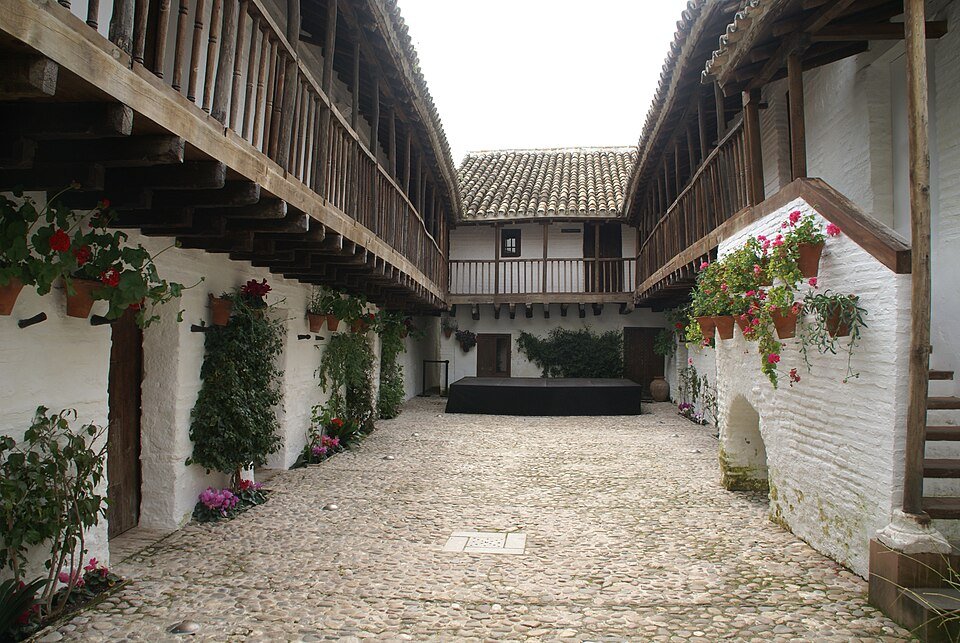
From the street, an inn might look like any other house. A courtyard changes that impression: it directs movement towards galleries and rooms, connecting places for rest with spaces for everyday work. Here, the architecture helps us think about travellers arriving with belongings and animals, without inventing the adventures of a particular guest.
The Fosforito Flamenco Centre describes its home as a fifteenth-century casa de corrales, a courtyard building. Its account places former stables around the patio and small upper rooms off wooden galleries. The surviving complex has experienced changing uses and alterations; the early date does not mean that every feature visible today is medieval.
From passing guests to resident neighbours
Commerce and craft activity around the square encouraged inns and taverns. This building belonged to the practical city: arriving, storing belongings, finding a bed and moving on. Its significance does not depend on every traveller having left a famous name.
The centre’s own chronology distinguishes three stages: an inn until the mid-nineteenth century, a corral de vecinos—housing arranged around a shared courtyard—until the mid-twentieth century, and a municipal cultural centre from 2013 following its recovery. Keeping those stages separate avoids confusing temporary lodgings with family homes, or presenting the building as a working inn today.
Cervantes: a literary lead, not a guest register
The centre recalls the inn’s presence in Cervantes’s literary world. That connection invites us to revisit a landscape of roads and lodgings, but a literary reference is not a guest register. We do not identify a particular night the writer spent here or turn fiction into established biography.
Today the centre explores flamenco and the singer Antonio Fernández, known as Fosforito. If you enter, first connect the scale of the courtyard with the upper gallery, then follow the centre’s displays. Check the official website for visiting arrangements and programmes: a visit does not automatically include a live performance.
Two ways of reading one courtyard
During your visit, compare the courtyard level with the upper gallery. Their arrangement suggests relationships between arrival, accommodation and circulation, even though the rooms now contain different displays. A museum changes what visitors do inside a building while retaining clues to its earlier organisation.
Two histories meet here: the architecture of an inn and the culture now explored within it. The former helps you read the courtyard; the centre’s rooms offer ways to listen to and learn about flamenco. Allow time for both, without assuming that a particular display or a live performance is available on every visit.
At your own pace
Audio guide
Posada del Potro: a courtyard for travellers · 3:04 · English
Preparing player…
Read the full transcript
Posada del Potro: a courtyard for travellers.
From the street, an inn might look like any other house. A courtyard changes that impression: it directs movement towards galleries and rooms, connecting places for rest with spaces for everyday work. Here, the architecture helps us think about travellers arriving with belongings and animals, without inventing the adventures of a particular guest.
The Fosforito Flamenco Centre describes its home as a fifteenth-century casa de corrales, a courtyard building. Its account places former stables around the patio and small upper rooms off wooden galleries. The surviving complex has experienced changing uses and alterations; the early date does not mean that every feature visible today is medieval.
Commerce and craft activity around the square encouraged inns and taverns. This building belonged to the practical city: arriving, storing belongings, finding a bed and moving on. Its significance does not depend on every traveller having left a famous name.
The centre’s own chronology distinguishes three stages: an inn until the mid-nineteenth century, a corral de vecinos; housing arranged around a shared courtyard; until the mid-twentieth century, and a municipal cultural centre from twenty thirteen following its recovery. Keeping those stages separate avoids confusing temporary lodgings with family homes, or presenting the building as a working inn today.
The centre recalls the inn’s presence in Cervantes’s literary world. That connection invites us to revisit a landscape of roads and lodgings, but a literary reference is not a guest register. We do not identify a particular night the writer spent here or turn fiction into established biography.
Today the centre explores flamenco and the singer Antonio Fernández, known as Fosforito. If you enter, first connect the scale of the courtyard with the upper gallery, then follow the centre’s displays. Check the official website for visiting arrangements and programmes: a visit does not automatically include a live performance.
During your visit, compare the courtyard level with the upper gallery. Their arrangement suggests relationships between arrival, accommodation and circulation, even though the rooms now contain different displays. A museum changes what visitors do inside a building while retaining clues to its earlier organisation.
Two histories meet here: the architecture of an inn and the culture now explored within it. The former helps you read the courtyard; the centre’s rooms offer ways to listen to and learn about flamenco. Allow time for both, without assuming that a particular display or a live performance is available on every visit.
Posada del Potro stands in Plaza del Potro and houses the Fosforito Flamenco Centre. Check its official website for access and programmes. It is not Posadas, a separate municipality in Córdoba province. Combine the courtyard with the square’s fountain and choose a nearby museum if you wish.
Download for offline listening
Save this story before you leave. Its recording and page will be available in this browser. Maps, bookings and external links require a connection.
Locally generated neural narration · Emma · This story’s full script. Audio credits
What to notice and how to plan your visit
Posada del Potro stands in Plaza del Potro and houses the Fosforito Flamenco Centre. Check its official website for access and programmes. It is not Posadas, a separate municipality in Córdoba province. Combine the courtyard with the square’s fountain and choose a nearby museum if you wish.
Sources and a critical reading
Documented evidence, popular comparisons and interpretations are distinguished. Check current access arrangements before visiting. References are in Spanish unless marked English.