
What we know. The inscription dates the work to 1314–1315. Evidence survives alongside questions about the original setting; this building should not be attributed to Maimonides.
A date carried by the building
On Calle Judíos, Córdoba’s Synagogue preserves an unusually direct clue to its history: a dedicatory inscription. Its Hebrew date falls in 1314 and 1315 in the calendar most visitors use. The date comes from the building itself, rather than from a story attached to it centuries later. The inscription names Isaac Moheb; variations in the spelling of his name reflect different transliterations.
This places the monument in medieval Córdoba under Castilian rule, after the Christian conquest of 1236. Its decoration draws on the artistic traditions of al-Andalus within that later setting. The term Mudéjar helps describe this relationship. Shared decorative techniques reveal exchanges of skill and visual language, while the communities involved retained distinct religious traditions and lived within an unequal society.
Entering a place of prayer
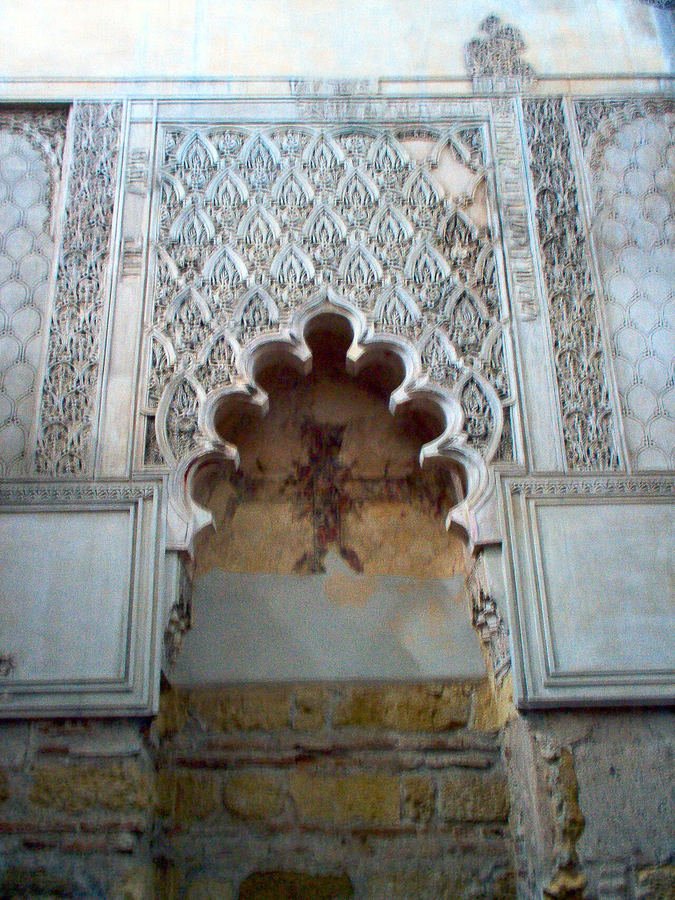
A small courtyard and vestibule separate the street from the main room. The Andalusian heritage authority describes a prayer hall of roughly forty square metres. That modest size rewards close observation. Notice the transition between the approach and the room, then follow the walls upwards. The arrangement of entrances, recesses and upper openings gives this compact interior its particular character.
The eastern wall preserves the space of the hejal, associated with keeping the Torah scrolls. An arch on the western side frames the position linked with the bimah, where sacred texts were read. On the southern side, the upper gallery is traditionally identified as the women’s gallery. Together, these features help explain how the room was used.
Reading the plasterwork
Geometric patterns and foliage share the walls with Hebrew inscriptions, including passages associated with the Book of Psalms. Writing belongs to the design: try following a band of lettering before looking again at the ornament around it. The plasterwork once had colour. What survives today includes ancient material, missing areas and the results of conservation; the bare surfaces also tell part of the story.
A building with later lives
Following the expulsion of the Jews in 1492, the building ceased to serve as a synagogue. Institutional visitor information records its later use as a hospital, a chapel dedicated to Saint Crispin and an infant school. Those changes help explain how the monument survived while its original purpose became harder to recognise. The recovery of plasterwork in 1884 and monument designation in 1885 brought a new focus on preservation.
There is one easy historical trap to avoid. Maimonides, whose statue stands nearby in the Jewish Quarter, lived in the twelfth century. This synagogue was built later. Both belong in the history of Jewish Córdoba, but placing the philosopher inside this particular room would bring together two different periods without evidence.
At your own pace
Audio guide
The synagogue dated in its walls · 3:12 · English
Preparing player…
Read the full transcript
The synagogue dated in its walls.
On Calle Judíos, Córdoba’s Synagogue preserves an unusually direct clue to its history: a dedicatory inscription. Its Hebrew date falls in thirteen fourteen and thirteen fifteen in the calendar most visitors use. The date comes from the building itself, rather than from a story attached to it centuries later. The inscription names Isaac Moheb; variations in the spelling of his name reflect different transliterations.
This places the monument in medieval Córdoba under Castilian rule, after the Christian conquest of twelve thirty-six. Its decoration draws on the artistic traditions of al-Andalus within that later setting. The term Mudéjar helps describe this relationship. Shared decorative techniques reveal exchanges of skill and visual language, while the communities involved retained distinct religious traditions and lived within an unequal society.
A small courtyard and vestibule separate the street from the main room. The Andalusian heritage authority describes a prayer hall of roughly forty square metres. That modest size rewards close observation. Notice the transition between the approach and the room, then follow the walls upwards. The arrangement of entrances, recesses and upper openings gives this compact interior its particular character.
The eastern wall preserves the space of the hejal, associated with keeping the Torah scrolls. An arch on the western side frames the position linked with the bimah, where sacred texts were read. On the southern side, the upper gallery is traditionally identified as the women’s gallery. Together, these features help explain how the room was used.
Geometric patterns and foliage share the walls with Hebrew inscriptions, including passages associated with the Book of Psalms. Writing belongs to the design: try following a band of lettering before looking again at the ornament around it. The plasterwork once had colour. What survives today includes ancient material, missing areas and the results of conservation; the bare surfaces also tell part of the story.
Following the expulsion of the Jews in fourteen ninety-two, the building ceased to serve as a synagogue. Institutional visitor information records its later use as a hospital, a chapel dedicated to Saint Crispin and an infant school. Those changes help explain how the monument survived while its original purpose became harder to recognise. The recovery of plasterwork in eighteen eighty-four and monument designation in eighteen eighty-five brought a new focus on preservation.
There is one easy historical trap to avoid. Maimonides, whose statue stands nearby in the Jewish Quarter, lived in the twelfth century. This synagogue was built later. Both belong in the history of Jewish Córdoba, but placing the philosopher inside this particular room would bring together two different periods without evidence.
Check the Junta de Andalucía’s current visitor information before setting out. Conservation work can affect access, and opening arrangements should not be assumed to remain unchanged. Follow the designated route and enjoy the plasterwork without touching it. Afterwards, explore the surrounding Jewish Quarter: the surviving synagogue is one remarkable part of a much wider urban history.
Download for offline listening
Save this story before you leave. Its recording and page will be available in this browser. Maps, bookings and external links require a connection.
Locally generated neural narration · Emma · This story’s full script. Audio credits
What to notice and how to plan your visit
Check the Junta de Andalucía’s current visitor information before setting out. Conservation work can affect access, and opening arrangements should not be assumed to remain unchanged. Follow the designated route and enjoy the plasterwork without touching it. Afterwards, explore the surrounding Jewish Quarter: the surviving synagogue is one remarkable part of a much wider urban history.
Sources and a critical reading
Documented evidence, popular comparisons and interpretations are distinguished. Check current access arrangements before visiting. References are in Spanish unless marked English.
- Junta de Andalucía · Sinagoga: inscripción, arquitectura y yeserías
- IMTUR · Sinagoga: contexto y usos posteriores
- IMTUR · Ficha histórica: recuperación en 1884 y protección en 1885
- Junta de Andalucía · Conservación y adecuación de la visita, 09/06/2026
- Hebrew University of Jerusalem · Center for Jewish Art: Synagogue in Córdoba · English