
What we know. This story concerns Martos Mill at the San Julián weir, not the Albolafia waterwheel. Its buildings and machinery changed through successive periods of use.
A working river
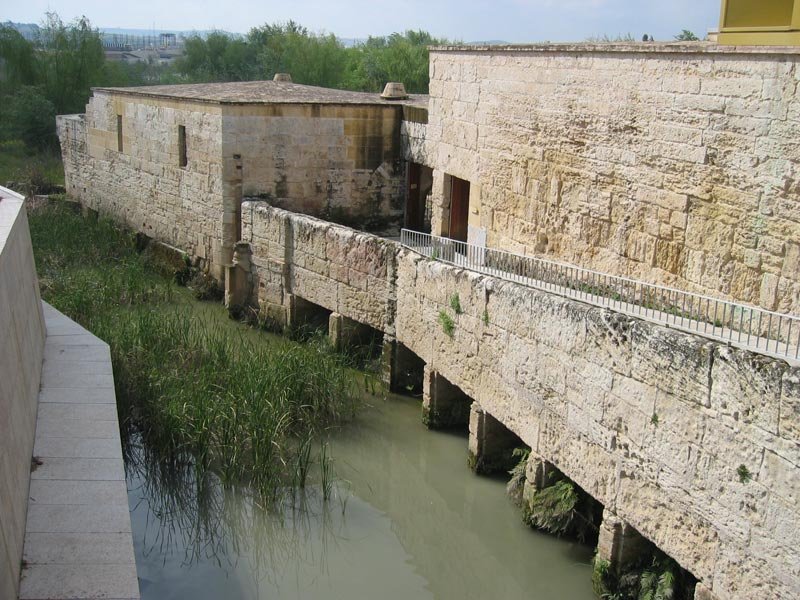
Beside the Guadalquivir, Martos Mill tells a story about turning moving water into useful work. It stands at the historic San Julián weir, near the former Martos Gate, from which its name derives. Looking at the building from the riverside connects an industrial history with the city’s old entrances and the wider river landscape.
The mill is documented from the Islamic period. After Córdoba’s Christian conquest in 1236, it became associated with the Order of Calatrava. This long history should not suggest an unchanged building. Heritage accounts distinguish earlier structures from the substantial transformation undertaken in the sixteenth century, when both its appearance and its technology developed.
Moving the machinery under the floor
The medieval mill used external vertical waterwheels. Between 1550 and 1555, a new building introduced the regolfo system, directing water beneath the floor to turn horizontal wheels within internal chambers. The change offers a useful way to think about a mill: channels, wheels, transmission mechanisms and working rooms together formed a single machine.
Eight grinding stones were installed, later increasing to ten. The brick-vaulted milling room remains an important part of this productive history. A millstone on its own tells only part of the story. Water had to be channelled, movement transmitted and grain handled by people who understood how to operate and maintain the equipment.
When water also worked cloth
Milling shared the site with fulling. Water-powered machinery operated wooden hammers that repeatedly struck cloth during its treatment. Sixteenth-century accounts describe the adaptation of part of the complex to this work. The same riverside setting could therefore contribute to more than one type of production, linking the mill with the city’s textile trades as well as its food supply.
The heritage designation for Córdoba’s Guadalquivir mills records Martos’s milling room and areas connected with fulling. Understanding them involves following relationships between spaces and movements. This is a reminder that Córdoba’s heritage includes the places where essential everyday work happened, alongside the buildings created for ceremony, worship or government.
Adaptation, abandonment and conservation
Martos passed into private ownership in 1839. Turbines were introduced towards the end of the nineteenth century, and intermittent operation continued before abandonment in the mid-twentieth century. These changes reveal efforts to keep the mill useful as technology developed. The building represents successive responses to the river, rather than one medieval moment preserved intact.
Modern rehabilitation by architect Juan Navarro Baldeweg prepared it for a cultural role explaining water and flour production. In 2009, Córdoba’s Guadalquivir mills received protected heritage status as a group. Their significance brings together architecture, machinery and the memory of work. The Albolafia, famous for its waterwheel elsewhere along the river, is a different site with its own history.
At your own pace
Audio guide
The mill that put the river to work · 3:24 · English
Preparing player…
Read the full transcript
The mill that put the river to work.
Beside the Guadalquivir, Martos Mill tells a story about turning moving water into useful work. It stands at the historic San Julián weir, near the former Martos Gate, from which its name derives. Looking at the building from the riverside connects an industrial history with the city’s old entrances and the wider river landscape.
The mill is documented from the Islamic period. After Córdoba’s Christian conquest in twelve thirty-six, it became associated with the Order of Calatrava. This long history should not suggest an unchanged building. Heritage accounts distinguish earlier structures from the substantial transformation undertaken in the sixteenth century, when both its appearance and its technology developed.
The medieval mill used external vertical waterwheels. Between fifteen fifty and fifteen fifty-five, a new building introduced the regolfo system, directing water beneath the floor to turn horizontal wheels within internal chambers. The change offers a useful way to think about a mill: channels, wheels, transmission mechanisms and working rooms together formed a single machine.
Eight grinding stones were installed, later increasing to ten. The brick-vaulted milling room remains an important part of this productive history. A millstone on its own tells only part of the story. Water had to be channelled, movement transmitted and grain handled by people who understood how to operate and maintain the equipment.
Milling shared the site with fulling. Water-powered machinery operated wooden hammers that repeatedly struck cloth during its treatment. Sixteenth-century accounts describe the adaptation of part of the complex to this work. The same riverside setting could therefore contribute to more than one type of production, linking the mill with the city’s textile trades as well as its food supply.
The heritage designation for Córdoba’s Guadalquivir mills records Martos’s milling room and areas connected with fulling. Understanding them involves following relationships between spaces and movements. This is a reminder that Córdoba’s heritage includes the places where essential everyday work happened, alongside the buildings created for ceremony, worship or government.
Martos passed into private ownership in eighteen thirty-nine. Turbines were introduced towards the end of the nineteenth century, and intermittent operation continued before abandonment in the mid-twentieth century. These changes reveal efforts to keep the mill useful as technology developed. The building represents successive responses to the river, rather than one medieval moment preserved intact.
Modern rehabilitation by architect Juan Navarro Baldeweg prepared it for a cultural role explaining water and flour production. In two thousand and nine, Córdoba’s Guadalquivir mills received protected heritage status as a group. Their significance brings together architecture, machinery and the memory of work. The Albolafia, famous for its waterwheel elsewhere along the river, is a different site with its own history.
The managing institution currently lists Martos Mill as temporarily closed. Check its latest notice before planning to enter. You can still understand its setting from authorised public riverside areas. Stay out of the riverbed and behind barriers; do not approach machinery through closed sections. From a safe viewpoint, connect the building, the weir and the direction of the current, allowing for changing river conditions.
Download for offline listening
Save this story before you leave. Its recording and page will be available in this browser. Maps, bookings and external links require a connection.
Locally generated neural narration · Emma · This story’s full script. Audio credits
What to notice and how to plan your visit
The managing institution currently lists Martos Mill as temporarily closed. Check its latest notice before planning to enter. You can still understand its setting from authorised public riverside areas. Stay out of the riverbed and behind barriers; do not approach machinery through closed sections. From a safe viewpoint, connect the building, the weir and the direction of the current, allowing for changing river conditions.
Sources and a critical reading
Documented evidence, popular comparisons and interpretations are distinguished. Check current access arrangements before visiting. References are in Spanish unless marked English.
- Real Jardín Botánico de Córdoba · Historia, tecnología y aviso de cierre temporal
- BOJA · Decreto 291/2009: molinos del Guadalquivir y descripción del Molino de Martos
- Consorcio de Turismo · Córdoba Cultural y Turística 5: evolución de las aceñas y sistema de regolfo
- IMTUR · Museo Hidráulico Molino de Martos